Showing posts with label eating. Show all posts

Monday, January 7, 2013

Does a high fat diet lead to a less 'rewarding' life?

Some interesting research out of the University of Pennsylvania suggests that a high fat diet can disrupt dopamine signalling.

This high-fat fed rat sure looks happy to me (source)
As I briefly discussed during my SfN Neuroblogging binge, a high fat diet can alter dopamine levels in the brain. To expand on this, we'll look at new research on how exactly this might happen and which specific areas of the brain are affected.  

Vucetic et. al. (2012) tested the levels of dopamine-related gene expression (via mRNA) in the hypothalamus and the ventral tegmental area (VTA). The hypothalamus is important because it controls your levels of hunger as well as many other things. The VTA is important because it is the main source of dopamine to the ventral striatum (AKA the Nucleus Accumbens). The VTA-nucleus accumbens pathway is generally thought to signify 'reward' when it is activated. Sex, Drugs, Music, and lots of other 'pleasurable' activities all activate this pathway. So alterations in the dopamine levels here might change how 'rewarded' a person (or mouse in this case) feels in response to pleasurable stimuli.

So Vucetic et al., (2012) found that in the VTA, the levels of tyrosine hydroxylase ("TH", an enzyme indicative of how much dopamine can be made) and dopamine active transporter ("DAT", which gets rid of excess dopamine at the synapse) are both reduced in the mice eating the high fat diet.

Vucetic et al. (2012) Figure 1
By contrast, in the hypothalamus, TH and DAT are both increased due to the high fat diet.

So what does this mean? The authors point out that increased dopamine in the hypothalamus actually promotes eating. Consistent with this idea, the authors show that mice eating the high fat diet actually ate more frequently and ate more total food. Secondly, when there is less dopamine in the VTA, it is likely that a rewarding stimuli will seem less rewarding. 

In the author's words:
"Collectively, these behaviors have the potential to promote obesity in two distinct ways: (i) through an increase in food intake and (ii) by increasing the drive for palatable food, as the animal with a blunted response to palatable foods may seek and/or consume these food relatively more than a normal animal in order to reach the same rewarding response. "
So basically the mice aren't obese because the food they are eating is high fat, they are obese because they are eating MORE food. But of course, they are eating more food because the high fat diet makes them 'want' to eat more food, so the high fat diet is indirectly causing the weight gain.

It is truly a vicious cycle.

 *Note: They also look at epigenetic effects on the TH and DAT promoter DNA. If you are interested in that aspect of the study, comment and I can do a follow-up post explaining it, or you can just read the study for yourself, following the link below. 

© TheCellularScale

ResearchBlogging.org
Vucetic Z, Carlin JL, Totoki K, & Reyes TM (2012). Epigenetic dysregulation of the dopamine system in diet-induced obesity. Journal of neurochemistry, 120 (6), 891-8 PMID: 22220805

Tuesday, October 16, 2012

SfN Neuroblogging 2012: Implicit and Explicit Gender Bias

Today I am going to talk about just one thing rather than poster highlights from the whole day.
As always, all the SfN Neuroblogging posts can be found here. Other posts on gender and neurosexism can be found here.


Today was the annual "Celebration of Women in Neuroscience Luncheon." This is one of the highlights of SfN for me each year. There is always a fantastic speaker (Phyllis Wise this year) and the lunch is delicious.

Phyllis Wise brought up the 'exact same resume study' in her speech and it got me thinking. The 'exact same resume' study is where researchers construct a fake person and write up their resume, and then submit it in application for various jobs. However, sometimes they put a woman's name at the top and sometimes they put a man's name at the top. 

The study found that the male names received more and higher paying job offers and were judged to be more qualified. And it wasn't just that men thought women less capable. The females who judged the resumes were just as biased as the males who judged resumes. This is pretty depressing. I mean this isn't the middle ages, or even the Victorian era, aren't we past this bias?

But that's exactly the problem. We think we are past this bias. Even though people (both women and men) don't think they have a bias, they actually do. Even you. Just like you probably think you are smarter than average, or a better driver than average, you also probably think that you are less biased than average. That. is. the. problem. People have an implicit bias towards thinking men are smarter, better and more capable even when faced with the exact same description of the person. And they don't acknowledge this bias.

How can you combat or fix a bias that people don't even think they have? A gender blind resume process could be implemented in the initial application process for a jobs. But as soon as the applicant arrives for an interview, the gender bias would rear its ugly head. Should faculty or hiring committees develop an explicit bias towards women in their hiring and salary negotiation process?

I do not know the answer to this question. I can't think of a better way to combat implicit bias than with explicit bias, but it's hard to argue that implementing an explicit bias is 'fair' (It is a bias after all). It would especially seem unfair to those who don't think that they are implicitly biased (which we have established is basically everyone). But is there a fair way to handle this problem?

UPDATE (10/19/12): Thank you to Dario Maestripieri for helping me think about this problem in a new way. Perhaps the best way to start addressing an implicit bias is to make it explicit. When someone makes an idiotic or sexist comment, it should be made public. When someone gets grabby, it should be made public. The whole point of this post is that one of the biggest problems with gender bias in science is that people don't believe it is there. If it is made clear that it is there, people can more easily fight against it.

© TheCellularScale

ResearchBlogging.orgMoss-Racusin CA, Dovidio JF, Brescoll VL, Graham MJ, & Handelsman J (2012). Science faculty's subtle gender biases favor male students. Proceedings of the National Academy of Sciences of the United States of America, 109 (41), 16474-9 PMID: 22988126


Saturday, September 22, 2012

LMAYQ: Eating

Eating Questions (source)
Let Me Answer Your Questions, where I answer your important questions about things tangentially related to this blog. Today they are about eating. As always, these are real true 'search terms' that The Internet directed to The Cellular Scale. 


1."What physiological mechanisms makes food smell better when you are hungry?"

I almost address this in You can't trust your receptors: Smell, where I explain how the brain can actually modulate the sensitivity of the smell receptors themselves.

The real answer is that it is not exactly known, but it might have to do with grhelin. The hormone ghrelin is related to feeling hungry and a receptor for ghrelin is found in the olfactory (smell) pathways. One study actually tested whether ghrelin would affect a person's sense of smell.

Tong et al., 2011 gave people an IV injection of ghrelin and then tested how 'strongly they sniffed' with a 'sniff magnitude test (SMT)'. The higher levels of ghrelin correlated with a higher 'sniffing magnitude'. However, the sniffing magnitude was increased to both food and non-food smells. This means that people didn't necessarily inhale deeply because they liked the delicious smell of banana, they were just engaging in 'exploratory sniffing'. In addition, the authors had the smellers rate how pleasent the smell was, and the ghrelin did not increase the pleasentness ratings. 

So the actual physiological reason for food smelling better when you are hungry is still a mystery research question.


2. "best Madeleine recipe"

Well, this isn't exactly a question, but I am pretty sure this particular googler did not find what they wanted on my post on literature references in science. So here you go.  Though I have never made Madeleines, this one from Iamafoodblog.com looks delicious!


Earl Grey Madeleines Recipe adapted from 101 Cookbooks
yield: 7-8 large madeleines
  • 6 tablespoons butter
    1 egg
    3 tablespoons flour
    2.5 tablespoons sugar
    1/2 teaspoon loose leaf earl grey tea
    1/4 teaspoon vanilla
  • butter to grease madeleine pan
Preheat oven to 350 F.
Melt the butter in a small pot over medium heat. Add the tea and cool to room temperature. While the melted butter is cooling, grease the madeleine pan.
Put the egg in the bowl of an electric mixer with a whisk attachment. Whip on high speed until thick – approximately 3 minutes. The egg should double or triple in volume. Continuing to mix on high speed, and slowly add the sugar in a steady stream. Whip for 2 minutes or until mixture is thick. With a spatula, gently mix in the vanilla.
Sprinkle the flour on top of the egg batter, and gently fold in. Now fold in the butter mixture, stirring only enough to bring everything together. At this point, I like to refrigerate my batter for a bit. I find it helps with baking. Press saran wrap directly against the batter and refrigerate for at least 30 minutes.
Spoon the batter into the flutes, filling each 2/3 -3/4 full. Bake the madeleines for 12 – 14 minutes, or until the edges of the madeleines are golden brown. Remove from oven and unmold immediately.


3. "What does a mouse eat?"

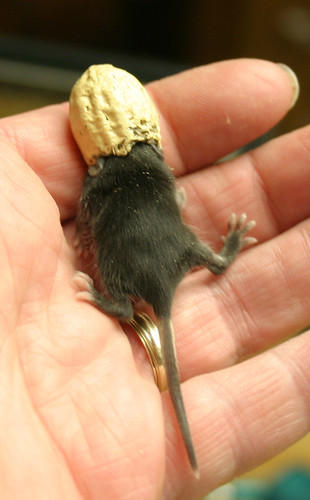
Peanut head (source)
Mice eat lots of things. If you have a pet mouse, you should feed it normal pet-store mouse food because it is a complete mouse diet.  But mice love new things, so you should give them oatmeal or peanuts or other seeds and grains as treats.

In some labs, mice and rats get to eat froot loops when they find the reward cup at the end of a maze. 


© TheCellularScale


ResearchBlogging.orgTong J, Mannea E, Aimé P, Pfluger PT, Yi CX, Castaneda TR, Davis HW, Ren X, Pixley S, Benoit S, Julliard K, Woods SC, Horvath TL, Sleeman MM, D'Alessio D, Obici S, Frank R, & Tschöp MH (2011). Ghrelin enhances olfactory sensitivity and exploratory sniffing in rodents and humans. The Journal of neuroscience : the official journal of the Society for Neuroscience, 31 (15), 5841-6 PMID: 21490225

Sunday, September 9, 2012

Taste cells in weird parts of your body

Everyone knows that taste and smell are intimately related, but what you might not know is that you have actual 'taste' cells in your nose (the nasal epithelium to be exact). 

Don't drink this way (source).
But before you go try to drink through your nose, read on, the story gets weirder.  These 'taste' cells express the T2R receptor which senses 'bitterness'. However, if you sniff some 'bitter' molecules into your nose, you won't feel like you are tasting bitterness because these cells don't go to the official 'taste' part of the brain.  In fact, they do something even cooler.  I'll let a previously-blogged-about author, Dr. Finger, explain:
"Since the SCCs synapse onto polymodal pain fibers in the trigeminal nerve, activation of the SCCs by bitter ligands evokes trigeminally mediated reflex changes in respiration." (Finger and Kinnamon 2011)

The SCCs are the 'solitary chemosensory cells' which are the 'taste' cells in the nose that I was talking about. And basically what Dr. Finger is saying is that when stimulated, these cells cause you pain and change the rate at which you breath. This is probably because it is not evolutionarily healthy to have something bitter up your nose and you might not want to breath it in deeply. Might be poison. 

If taste cells in the nose isn't weird enough, here is a diagram of all the other strange places in your body where 'taste' cells have been found:

Taste cells in the body Figure 2 (Finger and Kinnamon 2011)
So why do you need taste cells in your stomach? Well these cells don't send signals to the taste center of the brain either, but they do release ghrelin, which is an appetite-inducting peptide.  Since the taste receptors in the stomach have T1R receptors which respond to sweetness and amino acids (glutamate), this could be a signal saying 'yum, this is good stuff, keep eating'.

But why would there be taste cells in the bile duct? 
The authors of this review paper don't have that answer either:
"The composition of fluid in the bile ducts is dictated by secretions of the liver, pancreas, and gall bladder, so why is it necessary to diligently monitor the composition of biliary fluids and they move from gall bladder to intestines?" (Finger and Kinnamon 2011)
The moral of the story: Even though cells in weird parts of the body are shaped like taste cells and have taste receptors on them, they don't necessarily make you feel the feeling of taste, but they might serve other important survival functions.

© TheCellularScale

ResearchBlogging.org
Finger TE, & Kinnamon SC (2011). Taste isn't just for taste buds anymore. F1000 biology reports, 3 PMID: 21941599

Thursday, February 2, 2012

You can't trust your receptors: Smell

Food smells better when you're hungry, right? This is a common phenomenon that everyone I've ever talked to on the subject has experienced. For a long time, I assumed that the entire process underlying this phenomenon is in the brain proper, and not in the olfactory epithelium (that is, the smell receptors themselves).  However, a study on the adorable (and totally weird) salamander known as the 'Axolotl' suggests that the brain proper can actually modulate how sensitive those smell receptors are.
Axolotls (source)
yes, it does make a good pokemon character


Before I start explaining, let it be known that I am not saying the brain proper doesn't contribute to the 'food-smells-better-when-you're-hungry' phenomenon, in fact I would be very surprised if it didn't involve modulation of the ventral tegmental area, nucleus accumbens, and hypothalamus.

Mousley et al. (2006) use a technique called electro-olfactogram (EOG) to record the signals from smell receptors.  When the cells are excited by an odor, the size of the response can be recorded. They are using this technique in Axolotls, but it can be used in humans too:
EOG recording in humans (source)
Using this technique, Mousley et al. tested whether the size of the smell cells' signal could be modulated by a neuropeptide that is found in the terminal nerve (the nerve that connects the brain proper to the smell-sensing cells).  Chemicals that 'act like' this peptide can have confounding side effects, so the experimentors went to a lot of trouble to make sure they were using the peptide that is actually expressed in these animals.  They copied and synthesized this peptide from the genome of the axolotl. 

So what did they find? The found that this peptide (NPY) could modulate the size of the EOG response in hungry axolotls.  They applied the same amount of odor molecule and the same amount of NPY for each recording, so the increase in response is not due to more odor molecules or more NPY being present.  They suggest that it might be due to mory NPY receptors on the smell cells themselves, indicating that when hungry, the  smell cells change in these animals. 


Mousley et al., 2006 Fig4

So what does that mean? It means that when the animal is hungry, the brain proper has the ability to change the excitability of the smell receptors by dropping some NPY on them (through the terminal nerve).

This study showed the one specific peptide had an effect, but the principle that the brain can actually change the way the peripheral receptors sense things really struck me.  I had always thought that the receptors were pretty much stable, and pretty much always sent the same signal to the brain, but that the way the brain interpreted  that signal could be different. It fundamentally changed my view of sensory cells to learn that the smell receptors don't always send the same signals to the brain. 

source
  It made me rethink the studies that show expectation of taste changes the interpretation. The north dakota wine studies, and the wine-taste evaluation studies show that people rate things differently depending on what they are expecting. A common response is 'ha, what idiots to be influenced by the label of the wine and not trust their own tastebuds' when one reads about studies that show people evaluate white wines with red food coloring as if they were red wines and the like.

However, now I give these wine tasters more credit.  Perhaps the untrustworthy smell cells were actually altered by the brain's expectation. I haven't seen any study testing this idea with EOGs on humans, but I think it would make a great experiment.   


This post was chosen as an Editor's Selection for ResearchBlogging.org

 
ResearchBlogging.orgMousley A, Polese G, Marks NJ, & Eisthen HL (2006). Terminal nerve-derived neuropeptide y modulates physiological responses in the olfactory epithelium of hungry axolotls (Ambystoma mexicanum). The Journal of neuroscience : the official journal of the Society for Neuroscience, 26 (29), 7707-17 PMID: 16855098

Monday, January 23, 2012

The cells that make us eat: Part 2

In the last post, we discussed the finding that stimulating the AgRP neurons in the hypothalamus directly causes mice to eat.  You can see the video of the mouse eating with the light stimulation here.

Today we will look at a follow up paper by the same group.  This paper looks at the mechanisms that might naturally stimulate these neurons.  As the authors mention in the discussion, the origin of the pathways that naturally cause these neurons to fire is not known. (as in, the part of the brain that sends the main signals to these neurons is still a mystery)  However, they can investigate what is happening at the junction between these pathways and the AgRP neurons, that is, at the synapse.

Using brains from mice that are either hungry or full, the researchers found that in hungry mice, the AgRP neurons recieve more synaptic input. 

But why?

There are a few ways this could happen.  One possibility is that the upstream neurons are firing more frequently because they are receiving more input from other pathways. But since it is not known where these neurons are, that is difficult to test.  Another possibility is that the output ends of these neurons, the part which arrives at the synapse, releases neurotransmitter more easily in hungry mice than in full mice. 

The research in this paper supports option number 2, that the hunger signal modulation occurs right at the synapse.

The researchers find that through a complex molecular pathway, involving ghrelin, leptin, and opioid signalling, the neurotransmitter release at the synapse is regulated by the animal's hunger state. Although too detailed to fully summarize here, the paper presents a satisfying and thorough explanation for how the AgRP neurons (the ones that cause eating when stimulated) could be modulated by hunger signals from the body. 

One of the nice parts about this explanation is that it avoids the 'never ending chain of neurons' problem, where activity in one neuron is caused by a neuron stimulating it, which in turn is caused by a neuron stimulate that one, which is caused by... you get the point. 
This paper strongly suggests that dynamic modulation of eating behavior can happen right at the synapse.

ResearchBlogging.org Yang Y, Atasoy D, Su HH, & Sternson SM (2011). Hunger states switch a flip-flop memory circuit via a synaptic AMPK-dependent positive feedback loop. Cell, 146 (6), 992-1003 PMID: 21925320

Friday, January 20, 2012

The cells that make us eat: Part 1

It is always exciting when a specific behavior can be directly linked to particular neurons. 
In this case, eating.  In March 2011, a paper came out from the Sternson lab at Janelia Farm explaining that when certain neurons (AgRP) in the mouse hypothalamus were stimulated with light, the mouse would spontaneously start eating.  The mouse would pretty much keep eating (except for water breaks) until the stimulation stopped.  What's even more interesting is that the neurons right next to these (POMC) had pretty much the opposite effect.  When they were stimulated, the mouse didn't eat much and over time lost weight.

This may seem like the basis for the next miracle diet,  find a way to stimulate POMC neurons and suppress AgRP neurons, right?

Unfortunately it's not that easy.  There is a lot more work to be done.  In fact this is just the beginning of understanding the hunger circuit.  Sure stimulating the neurons directly with light causes eating, but what naturally stimulates those neurons? 

Neurons fire when they recieve signals from other neurons which in turn fire when they receive signals from other neurons.... and so forth in a never ending chain.

So, where does the 'must eat' signal ultimately come from?
where is the beginning of that neural chain?

We will investigate this a little more in Part 2, when we look at a follow up paper.

ResearchBlogging.org Aponte Y, Atasoy D, & Sternson SM (2011). AGRP neurons are sufficient to orchestrate feeding behavior rapidly and without training. Nature neuroscience, 14 (3), 351-5 PMID: 21209617