Showing posts with label The Senses. Show all posts

Monday, April 22, 2013

Connecting Form and Function: Serial Block-face EM

The retina is a beautiful and wondrous structure, and it has some really weird cells.

Retina by Cajal (source)
Retinal Ganglion Cells (RGC) have all sorts of differentiating characteristics. Some are directly sensitive to brightness (like rods and cones), while some are sensitive to the specific direction that a bar is traveling.

I am discussing really amazing new techniques to see inside cells this month, and have already posted about the magic that is Array Tomography. Today we'll look at another amazing new technique that (like array tomography) combines nano-scale detail with a scale large enough to see many neurons at once. This technique is called Serial Block-face Electron Microscopy (SBEM), and was recently used to investigate how starburst amacrine cells control the direction-sensitivity of  retinal ganglion cells.


Serial Block-face EM (source)

SBEM images are acquired by embedding a piece of tissue (like a retina) in some firm substance and slicing it superthin (like 10s of nanometers thick) with a diamond blade. The whole slicing apparatus is set up directly under a scanning electron microscope, so as soon as the blade cuts, an image is taken of the surface remaining. Then another thin slice is shaved off and the next image is taken, and so on.

Using this technique, Briggman et al. (2011) are able to trace individual neurons and their connections for a (relatively) large section of retina. What is so great about this paper is that before they sliced up the retina, they moved bars around in front of it and measured the directional selectivity of a bunch of neurons. Then, using blood vessels and landmarks to orient themselves, they were able to find the exact same cells in the SBEM data and trace them.

Briggman et al. (2011) Fig1C: Landmark blood vessels
The colored circles above represent the cell bodies and the black 'tree' shape are the blood vessel landmarks.

Once they found the cell bodies, the could trace the cells through the stacks of SBEM data. What is really neat is that you can try your hand at this yourself. This exact data set has been turned into a game called EYEWIRE by the Seung lab at MIT.

Reconstructing the cells, they could not only tell which cells connected to which other cells, but they could also see exactly where on the dendrites the cells connected. This is the really amazing part. They found that specific dendritic areas made synapses with specific cells.

Briggman et al. (2011) Fig4: dendrites as the computational unit

This starburst amacrine cell overlaps with many retinal ganglion cells (dotted lines represent the dendritic spread of individual RGCs)...BUT its specific dendrites (left, right, up down etc) synapse selectively onto RGCs sensitive to a particular direction. Each color represents synapses onto a specific direction-sensitivity. e.g. yellow dots are synapses from the amacrine cell onto RGCs which are sensitive to downward motion.

This suggests that each individual dendritic area of these starburst amacrine cells inhibits (probably) a specific type of RGC, and that these dendrites act relatively independently of one another.

"The specificity of each SAC dendritic branch for selecting a postsynaptic target goes well beyond the notion that neuron A selectively wires to neuron B, which is all that electrophysiological measurements can test. Instead the dendrite angle has an additional, perhaps dominant, role, which is consistent with SAC dendrites acting as independent computational units."  -Briggman et al (2011)(discussion)

These cells are weird for so many reasons, but the ability of the dendrites to act so independently of one another is a new and exciting development that I hope to see more research on soon.

© TheCellularScale


ResearchBlogging.org
Briggman KL, Helmstaedter M, & Denk W (2011). Wiring specificity in the direction-selectivity circuit of the retina. Nature, 471 (7337), 183-8 PMID: 21390125

Sunday, February 24, 2013

Scientizing Art

I've always been fascinated with the way the eye moves around a piece of art.

Andrew Wyeth's "Christina's World" (or as I looked up "that painting of a girl in a field looking at a house")

This piece by Andrew Wyeth is an obvious example of an artist completely controlling your gaze. There are pretty much no options here. You look at the girl and then you follow her gaze to the house. You probably then take a quick glance at that other house/barn to the left, and then maybe follow the edge of the light circle around the houses. (It's my opinion that that is how the eye should go on this painting, but I have no eye tracking data to support it.)

A paper last year in PLoS One really tries to "scientize' this process by testing what factors determine the eye movements, and the 'clusters' where the eye tended to fall. Massaro et al., (2012) compare dynamic and static images and images that contain human subjects or nature subjects. Their cluster analysis overlaying classic paintings makes for quite interesting images:

The next installment at MoMA

This one is a dynamic human image. Each patch of color shows where the parts of the painting where the eye lingers (face, hands, ....crotch...). The authors do all sorts of interesting analysis on this and other paintings, having participants rate the painting for 'movement' or for 'aesthetic value' and since the paper is open access, it is free to people who may not have university access to journal publications. Anyone can read the whole thing here.

One interesting thing that the authors find is that pictures containing humans have fewer clusters than pictures of nature. I expect this is because certain aspects of humans (faces, hands ...crotches...) are so salient and the brain focuses directly on them, while all the branches of a tree for example have about equal 'meaning' for a person.

science creates modern art
 Another great image from this paper. The authors show how much gazing was done at different parts of a painting through a heat map. This one is a human static image. The end result is actually quite haunting because the place that you want to look is blanked out (sort of like a Magritte painting).

So here are my questions: If someone looks at a blank page, where does their eye naturally go? Is there some sort of common pattern that most people use just to scan an area? Do chimpanzees use a similar pattern to scan a blank page? Does everyone have their own unique scanning pattern? Or is it just pretty much random? 

And here's an idea for artists: Buy yourself an eye tracker and have customers come use it and stare at a blank page. Trace their eye movements and then create a dynamic painting (or T-shirt, or napkin drawing) that follows the person's natural scanning patterns. This would be the ultimate in commissioned custom art! (Then give me one for free, because I think this sounds like fun.)

© TheCellularScale

ResearchBlogging.org
Massaro D, Savazzi F, Di Dio C, Freedberg D, Gallese V, Gilli G, & Marchetti A (2012). When art moves the eyes: a behavioral and eye-tracking study. PloS one, 7 (5) PMID: 22624007


Wednesday, January 30, 2013

Intuition or a sense of Smell?

I've long been fascinated by the idea that those feelings often attributed to 'intuition' or 'following your gut' might occur physiologically in the form of odor cues that we don't consciously register.

Intuition or Olfactuation? (source)
An example of this might me when you can just 'tell something is wrong' in a situation and decide to leave, and later found out that something bad happened later that evening. These sorts of stories are often used as evidence that people have psychic powers of some kind, and are equally often dismissed as just a coincidence.

But another possibility is that humans communicate through scents more than we realize. Maybe you could actually 'smell something is wrong' rather than supernaturally 'tell something is wrong' in the above hypothetical situation.

Researchers in the Netherlands tested whether the feelings of 'disgust' and 'fear' could be communicated through smell. They had guys watch scary parts of horror movies or disgusting graphic parts of MTV's Jackass while wearing 'sweat pads' in their armpits.

Who knew this would contribute to SCIENCE?

They then had female volunteers smell the sweat pads and measured their facial motions to see if the expressions they made were more like fear or disgust.

Importantly the protocol was double-blind, so neither the experimenters handing out the sweat pad vials, nor the participants had any idea what 'emotion' was sweated into those pads.

And they found what they thought they would find: the 'fear muscles' (Medial Frontalis) were most active for the women smelling the sweat of the horror-watching men, and the 'disgust muscles' (Levator Labii) were most active for the women smelling the sweat of the Jackass-watching men. In the authors words (stats taken out for readability):
"Moreover, fear chemosignals generated an expression of fear and not disgust, disgust chemosignals induced a facial configuration of disgust rather than fear, and neither fear, nor disgust, were evoked in the control condition" de Groot et al. (2012)
So at very very close range (like nose in armpit), it seems that emotional signals can be transmitted through scent.
The smell of fear (source)

A quick side note: the scent in this study was created by men and smelled by women. I wonder if this specific gender combination is necessary for the scent-based communication. You would think men smelling men and women smelling women would have the same effect, but they did not investigate other combinations.

If you learn anything from this, let it be to not go see a disgusting movie on a first date, you might end up repulsing each other with your 'disgust sweat' later.

© TheCellularScale

ResearchBlogging.org
de Groot JH, Smeets MA, Kaldewaij A, Duijndam MJ, & Semin GR (2012). Chemosignals communicate human emotions. Psychological science, 23 (11), 1417-24 PMID: 23019141

Tuesday, November 20, 2012

Virtual reality for your robot cockroach

I have previously covered some interesting advances in the world of cyborg insects.

Biobot backpack (cockroach size) (source)
Latif and Bozkurt from North Carolina state university recently presented a paper (though I can't find a peer-reviewed publication on Pubmed), explaining their Biobot. They use the Madacascar hissing cockroach...

Hissing Cockroach (source). Terrifying.
... and attach a electrically stimulating 'backpack' (see first picture). They then stimulate the the antennae in a variety of ways to 'steer' the Biobot.

"In these studies, electrical pulses were applied to the insect to create biomechanical or sensory perturbations in the locomotory control system to steer it in desired directions, similar to steering a horse with bridle and reins." -Latif and Bozkurt

This is very similar to the backyard brains Roboroach, but the system created by Latif and Bozkurt is extremely precise. Rather than just making the Biobot turn when stimulated, Latif and Bozkurt can make the cockroach walk a specified line.


Pretty cool. The authors note that generally the cockroaches want to walk straight until they encounter an obstacle (or stimulation). So, sure, this is sort of like steering a horse with reins, but the horse has to be trained to know what the bridle signals mean. This setup is more like creating a virtual reality for the cockroach, where it thinks that it has 'run into' something at certain points on the line. This is similar to creating a virtual reality for worms by stimulating specific neurons with light.

Of course the practical applications of this are a little iffy. People always seems to say that these little insect-bots could be of use in disaster settings where people need to get some ground level surveillance of a rubble-littered area, but I think the scientific applications for this are what is really exciting. Being able to create a virtual reality of any shape or size could allow for tests of spatial navigation in the cockroach. You could even try to train the cockroach to find something or avoid something and the 'confuse it' by changing the virtual environment suddenly. Could it adapt?

© TheCellularScale

Sunday, November 11, 2012

Cut your brain some SLACK

Action potentials are the main means of communication between neurons, and their exact timing can be really important. But the specific timing of action potentials is really important in the auditory system, because the auditory system encodes (among other things) information about sound wave frequency.
Sound waves (source)
I've previously written about auditory processing with regards to the wonder that is the chicken brain, but today we will focus on timing-specificity in the mammalian brainstem. Specifically, some weird channels in the Medial Nucleus of the Trapezoid Body (the MNTB).

Mammalian Auditory Brainstem (source)
At the Society for Neuroscience meeting, I learned about the sodium-activated potassium channels which help the electric fish fire super-fast super-large action potentials. I was suprised to learn that sodium-activated potassium channels are located in many parts of the mammalian brain.

A paper from the Kaczmarek lab at Yale explains that these sodium-activated potassium channel (SLICK and SLACK) are present in the mouse auditory brainstem and contribute to the 'temporal accuracy' of the MNTB neurons. Yang et al. (2007) record the action potentials from these neurons at a range of frequencies and show that the neuron can 'keep' up with the frequencies better when more sodium is present.
Yang et al., 2007 Figure 9B
In the figure above, the 'flatter' the line, the better the 'temporal accuracy.' They also made a computational model of this neuron and ran simulations altering the sodium values and reversal potential.
Yang et al., 2007 Figure 9D
Their model simulations are similar to their experimental recordings, in that more sodium results in more temporal accuary of the action potential. They confirmed that this was dues to a sodium-activated potassium channel by directly activating SLACK and seeing a similar improvement in temporal accuracy.

The SLACK channel still blows my mind, but its role in helping the auditory system fire with the utmost precision actually makes a lot of sense.


© TheCellularScale


ResearchBlogging.orgYang B, Desai R, & Kaczmarek LK (2007). Slack and Slick K(Na) channels regulate the accuracy of timing of auditory neurons. The Journal of neuroscience : the official journal of the Society for Neuroscience, 27 (10), 2617-27 PMID: 17344399

Monday, October 15, 2012

SfN Neuroblogging 2012: drunk birds, worms, and robot noses

After a distressing night of not having wifi in my hotel, I am finally able to put this post up.  All of the previous "SfN Neuroblogging" posts can be found here.

And now 3 more highlights from day 2 of SfN:

a bird and his beer (source)
1. Can songbirds be a good model organism in which to study the effects of alcohol? Well yes and no. A poster (207.14), presented by C.R. Olson explains that songbirds don't seem to get addicted to alcohol, so they might not make good subjects for alcoholism studies. But alcohol does effect their song learning. Basically when low levels (below the legal human driving limit) of alcohol were maintained in the songbird's bloodstream while the bird was learning its song, the bird crystallized its song earlier.  That is it stopped practicing and settled on a song faster that the sober birds. The meaning of this is still unclear, as the researchers still need to analyze how 'good' the songs are.

2. What can worms tell us about the relationship between voltage and calcium?  A poster (174.03) directly compared a voltage sensitive dye to a calcium sensitive dye it the C. Elegans nematode. H. Shidara's poster explains that the calcium and voltage signals in the AIY neuron do not necessarily correspond. When the voltage was elevated in the soma and dendrites, the calcium was really only elevated in the dendrites, not the soma. I didn't quite catch the putative explanation for this from the researchers, but I suspect the huge surface to volume difference in a cell body compared to a dendrite might have a strong effect on the calcium dye, but not the voltage dye.

3. Finally, a poster (174.06) explains a new method for making an odor sensor. C. Pickford explains that the drosophila larva (commonly referred to as a maggot) has only so many odor receptors but can detect gazillions of different odors (I don't have the exact numbers here). So basically he is trying to make an odor sensor modeled off of the actual larva nose. This would serve two main purposes: 1. to create an odor sensor that can sense many odors and 2. to actually understand how the larva might be processing the information from its few odor receptors to detect many scents. 

© TheCellularScale

Saturday, September 22, 2012

LMAYQ: Eating

Eating Questions (source)
Let Me Answer Your Questions, where I answer your important questions about things tangentially related to this blog. Today they are about eating. As always, these are real true 'search terms' that The Internet directed to The Cellular Scale. 


1."What physiological mechanisms makes food smell better when you are hungry?"

I almost address this in You can't trust your receptors: Smell, where I explain how the brain can actually modulate the sensitivity of the smell receptors themselves.

The real answer is that it is not exactly known, but it might have to do with grhelin. The hormone ghrelin is related to feeling hungry and a receptor for ghrelin is found in the olfactory (smell) pathways. One study actually tested whether ghrelin would affect a person's sense of smell.

Tong et al., 2011 gave people an IV injection of ghrelin and then tested how 'strongly they sniffed' with a 'sniff magnitude test (SMT)'. The higher levels of ghrelin correlated with a higher 'sniffing magnitude'. However, the sniffing magnitude was increased to both food and non-food smells. This means that people didn't necessarily inhale deeply because they liked the delicious smell of banana, they were just engaging in 'exploratory sniffing'. In addition, the authors had the smellers rate how pleasent the smell was, and the ghrelin did not increase the pleasentness ratings. 

So the actual physiological reason for food smelling better when you are hungry is still a mystery research question.


2. "best Madeleine recipe"

Well, this isn't exactly a question, but I am pretty sure this particular googler did not find what they wanted on my post on literature references in science. So here you go.  Though I have never made Madeleines, this one from Iamafoodblog.com looks delicious!


Earl Grey Madeleines Recipe adapted from 101 Cookbooks
yield: 7-8 large madeleines
  • 6 tablespoons butter
    1 egg
    3 tablespoons flour
    2.5 tablespoons sugar
    1/2 teaspoon loose leaf earl grey tea
    1/4 teaspoon vanilla
  • butter to grease madeleine pan
Preheat oven to 350 F.
Melt the butter in a small pot over medium heat. Add the tea and cool to room temperature. While the melted butter is cooling, grease the madeleine pan.
Put the egg in the bowl of an electric mixer with a whisk attachment. Whip on high speed until thick – approximately 3 minutes. The egg should double or triple in volume. Continuing to mix on high speed, and slowly add the sugar in a steady stream. Whip for 2 minutes or until mixture is thick. With a spatula, gently mix in the vanilla.
Sprinkle the flour on top of the egg batter, and gently fold in. Now fold in the butter mixture, stirring only enough to bring everything together. At this point, I like to refrigerate my batter for a bit. I find it helps with baking. Press saran wrap directly against the batter and refrigerate for at least 30 minutes.
Spoon the batter into the flutes, filling each 2/3 -3/4 full. Bake the madeleines for 12 – 14 minutes, or until the edges of the madeleines are golden brown. Remove from oven and unmold immediately.


3. "What does a mouse eat?"

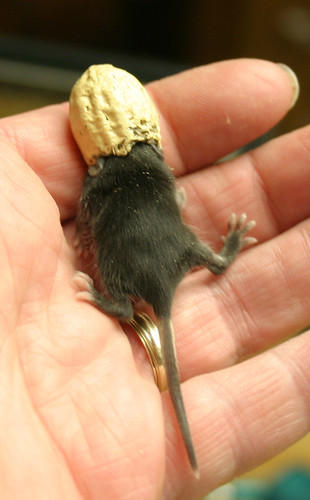
Peanut head (source)
Mice eat lots of things. If you have a pet mouse, you should feed it normal pet-store mouse food because it is a complete mouse diet.  But mice love new things, so you should give them oatmeal or peanuts or other seeds and grains as treats.

In some labs, mice and rats get to eat froot loops when they find the reward cup at the end of a maze. 


© TheCellularScale


ResearchBlogging.orgTong J, Mannea E, Aimé P, Pfluger PT, Yi CX, Castaneda TR, Davis HW, Ren X, Pixley S, Benoit S, Julliard K, Woods SC, Horvath TL, Sleeman MM, D'Alessio D, Obici S, Frank R, & Tschöp MH (2011). Ghrelin enhances olfactory sensitivity and exploratory sniffing in rodents and humans. The Journal of neuroscience : the official journal of the Society for Neuroscience, 31 (15), 5841-6 PMID: 21490225
Sunday, September 9, 2012

Taste cells in weird parts of your body

Everyone knows that taste and smell are intimately related, but what you might not know is that you have actual 'taste' cells in your nose (the nasal epithelium to be exact). 

Don't drink this way (source).
But before you go try to drink through your nose, read on, the story gets weirder.  These 'taste' cells express the T2R receptor which senses 'bitterness'. However, if you sniff some 'bitter' molecules into your nose, you won't feel like you are tasting bitterness because these cells don't go to the official 'taste' part of the brain.  In fact, they do something even cooler.  I'll let a previously-blogged-about author, Dr. Finger, explain:
"Since the SCCs synapse onto polymodal pain fibers in the trigeminal nerve, activation of the SCCs by bitter ligands evokes trigeminally mediated reflex changes in respiration." (Finger and Kinnamon 2011)

The SCCs are the 'solitary chemosensory cells' which are the 'taste' cells in the nose that I was talking about. And basically what Dr. Finger is saying is that when stimulated, these cells cause you pain and change the rate at which you breath. This is probably because it is not evolutionarily healthy to have something bitter up your nose and you might not want to breath it in deeply. Might be poison. 

If taste cells in the nose isn't weird enough, here is a diagram of all the other strange places in your body where 'taste' cells have been found:

Taste cells in the body Figure 2 (Finger and Kinnamon 2011)
So why do you need taste cells in your stomach? Well these cells don't send signals to the taste center of the brain either, but they do release ghrelin, which is an appetite-inducting peptide.  Since the taste receptors in the stomach have T1R receptors which respond to sweetness and amino acids (glutamate), this could be a signal saying 'yum, this is good stuff, keep eating'.

But why would there be taste cells in the bile duct? 
The authors of this review paper don't have that answer either:
"The composition of fluid in the bile ducts is dictated by secretions of the liver, pancreas, and gall bladder, so why is it necessary to diligently monitor the composition of biliary fluids and they move from gall bladder to intestines?" (Finger and Kinnamon 2011)
The moral of the story: Even though cells in weird parts of the body are shaped like taste cells and have taste receptors on them, they don't necessarily make you feel the feeling of taste, but they might serve other important survival functions.

© TheCellularScale

ResearchBlogging.org
Finger TE, & Kinnamon SC (2011). Taste isn't just for taste buds anymore. F1000 biology reports, 3 PMID: 21941599

Wednesday, August 22, 2012

Twists and turns on smell's evolutionary road

Smell is a complicated sense and its evolutionary path is a convoluted one. Olfactory receptor cells developed different shapes and different chemical receptors and were sometimes divided into separate organs and sometimes not.

Rainbow Goldfish: experimental animal (source)

A research group from the Rocky Mountain Taste and Smell Center (not affiliated with Coors) decided to research the olfactory cells of the noble goldfish. Goldfish are an interesting vertebrate because they, like humans, do not have the pheromone-sensing vomeronasal organ (though rats, a much closer evolutionary relative, do have it).

This group published a paper analyzing the morphology and chemical signature of the different types of smell cells in the goldfish olfactory epithelium (basically the back of the nose). Since Form and Function is one of my favorite topics, this paper sparked my interest. 

Hansen et al. (2004) show that there are three main shapes for the goldfish smell cells.

Hansen et al., 2004 Figure 3 (3 types of cells in the goldfish olfactory epithelium)
There are the Ciliated, the microvillous, and the crypt cells. 

"Ciliated ORNs are tall cells, with their nuclei usually located in the lower half of the OE. The cells possess a narrow dendrite and long apical processes radiating from an olfactory knob at the distal end (Fig. 3). Crypt receptor cells are obvious because of their typical ovoid shape and location in the upper half of the OE (Fig. 3). These ORNs possess microvilli that border the apical rim of the cell. At the same time, they possess cilia that are located in a “crypt”-like invagination." Hansen et al., 2004
Hansen et al. wanted to see whether these morphological characteristics correlated with the chemical signature of the cell. More specifically, they wanted to see which type of receptors these cells had and which g protein they expressed. 

They found that there was a direct correlation between the shape of the neuron and the type of smells it was sensitive to (as indicated by the receptors and g proteins it expresses). 

The most interesting finding was that the microvillous and crypt cells in the goldfish have very similar characteristics to the cells in the rat vomeronasal organ, and probably also serve the function of sensing pheromones. The paper inspires questions about why rats might have evolved a separate organ to house their pheromone receptors, while goldfish have all their receptors packed into one organ. Why would a separate organ be necessary if a range of informative odors can be sensed using one organ?

Eisthen (2004)
In her commentary on the paper, Eisthen presents an evolutionary tree showing the animals that have the vomeronasal organ and those that do not.  (I've blogged about her work on the olfactory sense of the axolotl here)


Even though goldfish have all these cells in one organ, the cell types aren't evenly intermixed.  The microvillous and crypt cells are concentrated closer to one end. The authors speculate that the differential location of these cells within the goldfish olfactory epithelium might be an intermediate evolutionary step towards an actual separate organ.


© TheCellularScale


ResearchBlogging.orgHansen A, Anderson KT, & Finger TE (2004). Differential distribution of olfactory receptor neurons in goldfish: structural and molecular correlates. The Journal of comparative neurology, 477 (4), 347-59 PMID: 15329885


Eisthen HL (2004). The goldfish knows: olfactory receptor cell morphology predicts receptor gene expression. The Journal of comparative neurology, 477 (4), 341-6 PMID: 15329884

Wednesday, August 15, 2012

LMAYQ: Can Odor be recorded?

Let Me Answer Your Questions: part 2, in which I answer your very important questions via google search terms. Part 1 and all subsequent LMAYQ posts will be archived in the LMAYQ index.

by Likarious
So let's get to it, what fascinating questions are you asking google?


1. "Can odor be recorded?"  

This likely brought someone to my post "You can't trust your receptors:smell" in which I discuss the EOG (electrolfactogram) where you can record the electrical activity of a smell receptor while certain smells are presented.  But it does not answer the question of whether a smell itself can be recorded.

So I looked into it a little bit and surprisingly, the answer is yes!

Nakamoto and others have created an "odor recorder"

Nakamoto 2005 figure 1
Unlike visual recording, which only need red, green, and blue to make essentially all the colors, odor recording requires a few more components. For example, the authors created an apple smell using 8 components.

I would love to say that this odor recorder is going to appear in every living room and plug into the TV so that restaurant and perfume marketing can be truly effective, I just don't see the demand being strong enough to make it worth mass producing. Though, I think it would be pretty amazing. 

I also had doubts as to whether the odor recorder could accurately transmit the scent of a really nice perfume which is not static, but develops over time. But The 2005 Nakamoto paper shows that they can actually record the changes of an odor over time!

While there is always the fact that a perfume reacts differently with every one's skin, the odor recorder actually seems like a promising device and might find a market in die hard perfume fans.

or..."odor recorder prevents murder"

The quest to permanently record the scent of a woman drives a man to murder in the mediocre movie "Perfume: the Story of a Murderer."  If only he was in possession of an odor recorder.

© TheCellularScale

ResearchBlogging.orgNakamoto T (2005). Study of odor recorder for dynamical change of odor. Chemical senses, 30 Suppl 1 PMID: 15738143

Tuesday, August 7, 2012

A new look at light

You might know that your retina senses light primarily through its rods and cones which are sensory cells specialized in converting photons into electrical signals.

Pisa at Sunset (I took this picture)


What you might not know is that there is a third light-sensitive cell in the mammalian eye. These cells are retinal ganglion cells (RGCs), but not all RGCs are directly sensitive to light.

But what you really probably don't know is that these RGCs sense light using the same protein that allows a toad's (Xenopus Laevis) skin to sense light (melanopsin). 

"It's true, I tell ya!"
These cells (the non-rod, non-cone light sensors) react to light directly, but they aren't exactly good at it. Their sensitivity is lower than the rods and cones, and they don't seem to transmit shape or color information.  So what is their purpose? Why have a secondary set of cells that sense light in a poor and unfocused way when you already have highly specialized rods and cones? 

To make it even more confusing, the rods and cones actually connect to these cells, adding their light-sensing information to theirs. 

weird, right? In a recent review paper, Pickard and Sollars (2012) explain that these cells likely play a role in controlling the sleep-wake cycle (circadian rhythm). Rats and mice with strongly degenerated rods and cones still set their circadian clock by the light cycle they are exposed to.  These cells send strong projections to the hypothalamus which controls everything sleep-wake cycle.


In addition, these cells or at least the melanopsin gene, may play a role in Seasonal Affective Disorder (SAD) by modulating the light-dependent cycles of the suprachiasmatic nucleus (a part of the hypothalamus).


SAD (source)


Their vague ability to sense 'brightness' makes these cells nicely suited to regulating the body's response to daily and seasonal changes in light. But whether these cells need to be light-sensitive to perform these functions or whether their sensitivity to light is just an evolutionary remnant is unclear. 


© TheCellularScale


ResearchBlogging.org
 Pickard GE, & Sollars PJ (2012). Intrinsically photosensitive retinal ganglion cells. Reviews of physiology, biochemistry and pharmacology, 162, 59-90 PMID: 22160822


Friday, August 3, 2012

The effect of familiar male voices on neurons

male zebra finch trying to impress female (Max-Planck)
Zebra finches are a popular model for language learning because unlike most research animals which may have instinctual vocalizations, zebra finches (the male ones at least) learn their signature song from experience.

The importance of social experience in male song learning is clear, but what about the effect of social experience on the female response to the male voice?

Menardy et al., 2012 (figure 2C)

Menardy et al., (2012) have recently analyzed the neural response in females to the male distance calls (not songs).  They tested the  response in anesthetized birds, but also in awake, alert birds. To do so, they used a nifty little recording device that they mounted on the back of the females.


They tested the response of the neurons in the caudomedial nidopallium (NCM) to the calls of the female's mate (4 months spent together), a non-mate familiar male (3 days spent together), and an unfamiliar male (complete stranger).

In general, the neurons in the female NCM responded more strongly to the calls of the males that they knew than to the stranger's call. 

Menardy et al., 2012 (figure 5A)

So why is this and what does it mean? The authors point out that this change in neural response could be a result of extensive social interactions (the female bird spent some quality time with the mate and the familiar male), or it could be a result of having heard the call before. 

In other words, Is the NCM encoding a recognition signal ('ah, that's Nick's voice') or a familiarity signal ('I've heard this sound before')?

It is likely that some form of neuroplasticity is taking place during the male-female interactions, but the mechanisms and the meaning behind it are not clear yet. Some interesting experiments might be to test the effect of traditional 'learning disruptors' (such as protein synthesis inhibitors) on this neural preference for familiarity. 

© TheCellularScale

ResearchBlogging.org
Menardy F, Touiki K, Dutrieux G, Bozon B, Vignal C, Mathevon N, & Del Negro C (2012). Social experience affects neuronal responses to male calls in adult female zebra finches. The European journal of neuroscience, 35 (8), 1322-36 PMID: 22512260

Thursday, July 19, 2012

The shape of a memory

Luna Moth (Source)
If an animal changes shape, do its memories change shape as well?
Blackiston et al., (2008) from Georgetown University designed an experiment to test exactly that question.

They exposed caterpillars to a specific smell and then gave them an electric shock. They then tested the caterpillar's aversion to the smell by letting it run around in a Y shaped structure.  One arm had the 'scary smell' and the other just had normal air.

Blackiston et al. 2008 figure 1


After the caterpillars had learned that the smell predicted an electric shock, they preferred the ambient air arm compared to the 'scary smell' arm. Specifically 78% of the caterpillars spent more time in the ambient air arm. 


So, great, caterpillars can learn to avoid a smell.  Not super exciting on its own.  The real test was to train the creature as a caterpillar and then test the creature as a moth.

And indeed, the moths remembered.  80% of adult moths chose the ambient air over the 'scary smell' air.  Interestingly, the moths only remembered if they were trained late in their caterpillar life, but not if they were trained as very young caterpillars.

So what does this mean? Well, like most fascinating scientific findings, it raises many questions.  In particular it makes me wonder what exactly is happening in the brain during metamorphosis?
Are the neurons even firing? Do they go into some kind of paused-frozen state?

I haven't heard of anyone recording the electrical signals from neurons or imaging the calcium dynamics of pupal moths or butterflies, but I think this would be a great experiment.

Clearly the caterpillar isn't completely destroyed and rebuilt, some components persist. The specific synaptic connections that encode the connection between the smell and the scariness must be maintained.

Metamorphosis (source)

And of course this answers the longstanding literary question of how exactly Gregor Samsa can remember who he is after he transforms into a cockroach.

© TheCellularScale

ResearchBlogging.org
Blackiston DJ, Silva Casey E, & Weiss MR (2008). Retention of memory through metamorphosis: can a moth remember what it learned as a caterpillar? PloS one, 3 (3) PMID: 18320055

Sunday, July 15, 2012

A Pain in the Hippocampus

Neuropathic Pain (source)
Pain is usually a helpful sign that something is wrong with a part of your body. Heat-pain will cause you to pull your hand back from something hot before it burns you. The pain of a cut will draw your attention to it, so you can clean it.

However damage to the central or peripheral nervous system can result in chronic neuropathic pain, which is not helpful form of pain. Neuropathic pain is basically some mis-firing or mis-connected pain neurons sending meaningless, but persistant pain signals to the brain. And as bad as that sounds, chronic pain can also apparantly wreak havoc on your brain.

A recent study by Mutso et al., (2012) shows that in both humans and experimental animals, the brain is actually re-organized in response to chronic pain.  Specifically, they look at pain-related changes in the hippocampus, the part of the brain most strongly implicated in memory encoding. 

They compared human patients with chronic back pain, complex regional pain syndrome, and osteoarthritis to people with no pain-related condition, and found that the people with both chronic back pain and with complex regional pain syndrome both had reduced hippocampal volume when compared with the normal control group. The osteoarthritis patients showed a trend toward reduced hippocampal volume, but the result was not statistically significant. 

Hippocampus (source)

So what does this mean? If you have chronic pain you have a smaller hippocampus? We've covered this kind of study before, basketball players had larger striatums that non-basketball players, but it is never really clear what the volume of a brain region tells us. 

Does the volume of a brain structure mean more neurons, more blood flow to that region, more glia cells, or differently shaped neurons?

It is very difficult to draw any conclusions about the effect of pain on the hippocampus simply by learning that the hippocampi of people with chronic pain are smaller than the hippocampi of normal people. 

Luckily the study did not end there. Mutso et al. also investigated the effects of chronic pain on the cellular level. 
Hippocampal Neurons (source)
They found that in mice with chronic pain, the hippocampus has fewer 'new' cells. By staining for two specific markers DCX and BrdU, you can tell which neurons are new.  The hippocampi of control (normal) mice had around 40 new cells, while the chronic pain mice had only 14.  This is an indication that neurogenesis is much reduced in response to chronic pain, and suggests that the reduction in hippocampal volume could be related to fewer new neurons being generated (though it does not show this conclusively).

Unfortunately, chronic pain is bad for your hippocampus, and a cure for both the pain and the collateral brain re-organization are still illusive. 

© TheCellularScale


ResearchBlogging.orgMutso AA, Radzicki D, Baliki MN, Huang L, Banisadr G, Centeno MV, Radulovic J, Martina M, Miller RJ, & Apkarian AV (2012). Abnormalities in hippocampal functioning with persistent pain. The Journal of neuroscience : the official journal of the Society for Neuroscience, 32 (17), 5747-56 PMID: 22539837